


Tirzepatide: dual-receptor biology and the evidence behind the medicine
NŪVO Insights · Emerging science. Clearly explained.
How to read the clinical trials while keeping authorised medicines separate from informal supplier labels.
Tirzepatide is often grouped under the broad heading of GLP-1 medicines, but its mechanism involves two receptor systems: glucose-dependent insulinotropic polypeptide, or GIP, and glucagon-like peptide-1, or GLP-1.
That scientific name is preferable to informal shorthand such as “TZ GLP1”. It identifies the subject of the clinical literature more clearly and avoids implying that a supplier’s label is itself a recognised medicine name.
What dual-receptor activity tells us
Dual activity describes the molecule’s interaction with two biological targets. It provides a rationale for investigation in metabolic disease, but it is the clinical programme that determines whether a particular intervention provides useful outcomes for patients. [1], [2]
Mechanism alone cannot establish an individual response. Nor does the number of targets provide a simple ranking against other medicines. Clinical comparisons require attention to population, study design, tolerability and the outcome being considered.
This matters because biological explanations and treatment claims are often compressed into a single sentence. They are better understood as connected stages of evidence.
What SURMOUNT-1 investigated
SURMOUNT-1 was a phase 3 randomised, double-blind, placebo-controlled study involving 2,539 adults with obesity, or overweight with a weight-related complication, without diabetes. It followed participants for 72 weeks and reported substantial average reductions in body weight in the tirzepatide groups. [1]
The population and duration are part of the finding. The study did not investigate every person who might want to lose weight, and its averages do not predict a guaranteed result for an individual.
The pharmaceutical intervention was also defined. The result is evidence about the trial medicine under the study conditions, not about every product that uses the word tirzepatide.
Why a separate diabetes trial matters
SURMOUNT-2 investigated adults with obesity or overweight and type 2 diabetes. It was also a randomised, placebo-controlled phase 3 study, with a 72-week duration. [2]
Studying that population separately helps answer questions that cannot simply be inferred from a trial excluding diabetes. Baseline metabolic conditions, accompanying medicines and the outcomes of interest can differ.
This is a useful general lesson for reading medical research: a larger body of evidence becomes more informative when its populations are distinguished, rather than blended into one headline number.
The UK medicine context
In November 2023, the MHRA authorised a weight-management indication for Mounjaro, a tirzepatide medicine, in eligible adults. The authorisation concerns a defined medicine and clinical criteria. [3]
Marketing authorisation, a clinician’s prescribing decision and access through the NHS are separate matters. A person’s suitability requires assessment; an article about the science cannot establish it.
Likewise, an authorised active ingredient does not make a research-labelled vial an authorised medicine. Formulation, manufacturing controls, supply chain and the product’s regulatory status remain relevant.
Benefits need to be read alongside risks
The MHRA highlights adverse effects and the potential for misuse of GLP-1 receptor agonist medicines, including tirzepatide’s dual-receptor formulation. Its guidance discusses gastrointestinal effects and potentially serious problems, and emphasises appropriate use. [4]
That context should accompany public discussion of clinical results. A study’s positive average outcome is not a statement that treatment is suitable for everyone or that monitoring is unnecessary.
This article does not provide dosing, titration, combination or sourcing advice. Questions about prescribed treatment belong with an appropriately qualified healthcare professional.
How to judge a comparison claim
Before accepting that one medicine is “better”, ask whether the comparison comes from a direct trial or from separate studies with different designs. Then check the actual endpoint. Weight change, blood-glucose control, cardiovascular outcomes and treatment discontinuation answer different questions.
A careful explanation can recognise tirzepatide’s substantial clinical evidence while remaining specific about where it applies. That is more useful than either treating all peptides as equally experimental or treating all tirzepatide-labelled materials as equivalent.
Sources and further reading
- Jastreboff et al.: SURMOUNT-1 trial (2022)
- Garvey et al.: SURMOUNT-2 in type 2 diabetes (2023)
- MHRA: Mounjaro weight-management authorisation (2023)
- MHRA: GLP-1 medicines, side effects and misuse
This article is provided for general educational purposes only. It is not medical advice and does not recommend the use, dose or sourcing of a prescription medicine or experimental compound. Consult an appropriately qualified healthcare professional about health concerns.
Explore the NŪVO research library
Hero image: conceptual scientific illustration; not a molecular model or evidence of a treatment effect.
Available to order
Compounds in this article
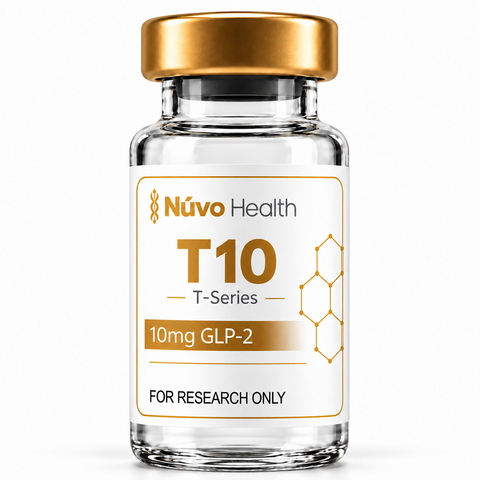
Supplied for laboratory research use only. Not for human or veterinary use.
