





MOTS-c: how mitochondria may communicate beyond energy production
NŪVO Insights · Emerging science. Clearly explained.
The research behind a mitochondrial-derived peptide, from metabolic models to exercise observations.
Mitochondria are often introduced as the structures that help cells produce usable energy. That description is useful, but incomplete. Researchers also investigate how mitochondria communicate with the rest of the cell and participate in responses to changing conditions.
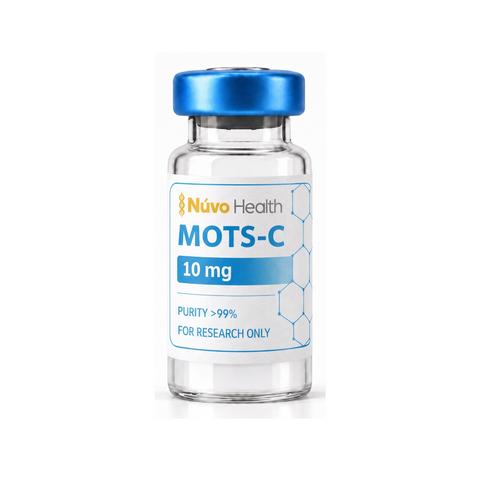
MOTS-c belongs to that broader story. It is a 16-amino-acid peptide associated with a short sequence in mitochondrial DNA, and its discovery opened questions about mitochondrial signalling beyond the familiar energy-producing machinery. [1]
What the discovery study showed
The 2015 report examined MOTS-c in cellular and mouse experiments related to metabolic homeostasis. The findings included effects on metabolic pathways and insulin sensitivity under the tested conditions. [1]
That work provided a reason to investigate the peptide further. It did not establish a human treatment for metabolic disease, nor did it show that a research product produces the same effects in everyday use.
The word “homeostasis” describes the regulation of internal conditions. In research, an intervention can affect part of that regulation without demonstrating an overall improvement in health. The model, the disturbance being studied and the measured response all matter.
A connection between mitochondria and the nucleus
In 2018, researchers reported that MOTS-c could move to the cell nucleus in response to metabolic stress and influence nuclear gene expression. The experimental response involved AMPK, a signalling system associated with cellular energy status. [2]
This finding is scientifically interesting because it links a mitochondrial-derived signal with activity in the nucleus, where most cellular genetic information is located. It expands the questions that can be asked about how cells adapt to changing energy conditions.
It should not be simplified into a claim that MOTS-c “switches on longevity”. The study addressed a cellular response. Lifespan, healthspan and clinical function are different outcomes that require their own evidence.
Why the exercise research is easy to misread
A 2021 paper investigated MOTS-c in relation to exercise and age-associated physical changes. Its human component measured responses around exercise in a small group of young men, while other parts of the work used experimental models. [3]
An increase in an endogenous molecule after exercise does not prove that administering that molecule reproduces exercise. Exercise changes many systems at once, and the rise of a biomarker may be part of a response rather than a sufficient cause of the resulting benefits.
This is the critical distinction between observing what the body does and testing what happens when an external intervention is introduced. The first can guide the second, but cannot substitute for it.
A framework for reading metabolic claims
When a MOTS-c claim mentions improved metabolism, ask which measurement is meant. Is it a change in cultured cells, glucose handling in mice, circulating peptide levels in humans or a meaningful clinical outcome after an intervention?
Those are not equivalent forms of evidence. A result can be compelling within its own setting while remaining uncertain outside it. Keeping the setting visible helps avoid both exaggerated optimism and unnecessary dismissal of useful basic science.
The exact material matters as well. A modified analogue, a labelled research tool and the original sequence may answer different questions. Findings should not be pooled solely because the names are related.
What would move the field forward?
Human intervention studies would need to establish appropriate exposure, safety and clinically relevant outcomes in defined populations. They would also need to distinguish effects on a biomarker from changes people can meaningfully experience or that reduce disease risk.
Longer follow-up and independent replication would make the evidence easier to interpret. The experiments discussed here are valuable contributions to that process, but they do not validate a personal-use regimen or a promise of extra energy, fat loss or slower ageing.
The NŪVO perspective
MOTS-c is most compelling as a window into mitochondrial communication. Its research encourages a more sophisticated view of mitochondria, while reminding us that an interesting internal signal is not automatically a proven external intervention.
Sources and further reading
- Lee et al.: discovery and metabolic homeostasis (2015)
- Kim et al.: nuclear translocation during metabolic stress (2018)
- Reynolds et al.: exercise and age-related physical function research (2021)
This article is provided for general educational purposes only. It is not medical advice and does not recommend the use, dose or sourcing of a prescription medicine or experimental compound. Consult an appropriately qualified healthcare professional about health concerns.
Explore the NŪVO research library
Hero image: conceptual scientific illustration; not a molecular model or evidence of a treatment effect.