
NAD+: what human studies add to the cellular story
NŪVO Insights · Emerging science. Clearly explained.
Understanding the difference between an essential coenzyme, an NAD-related biomarker and a demonstrated health outcome.
NAD+ is often grouped with peptides in longevity conversations, but it is not a peptide. Nicotinamide adenine dinucleotide is a coenzyme involved in cellular chemistry, including reactions connected with energy metabolism. Its importance to cells is well established. What follows from that importance is a separate question.
The central challenge in reading NAD+ research is to distinguish biology from intervention. A molecule can be essential for normal function without every method of increasing or supplying it producing a measurable improvement in health.
Three names that should stay separate
NAD+, nicotinamide riboside and nicotinamide mononucleotide are related, but they are not the same substance. Nicotinamide riboside is abbreviated to NR; nicotinamide mononucleotide is NMN. Both have been investigated as precursors within NAD metabolism. [1], [2]
That relationship does not make studies interchangeable. A trial of oral NR should be described as a trial of oral NR. It cannot automatically establish the effects of direct NAD+ administration, a different precursor or a different route.
This matters because the shortest marketing summaries often erase precisely those distinctions. “An NAD study showed…” is less informative than naming the actual intervention and explaining what changed.
A human study of NR
A 2018 randomised, double-blind, placebo-controlled crossover study investigated NR in healthy middle-aged and older adults. It reported that the intervention increased measures of NAD metabolism and was well tolerated over the study period. [1]
This supports a defined conclusion: the precursor changed relevant biological measurements in the participants studied. It does not demonstrate that it extends human lifespan or improves every aspect of ageing.
The duration also matters. Tolerability over several weeks is not the same as a complete long-term safety assessment. Both the positive finding and the boundary of that finding should remain visible.
A different question in NMN research
A 2021 trial investigated NMN in postmenopausal women with prediabetes. The researchers reported an improvement in muscle insulin sensitivity. [2] This is a human physiological outcome in a defined population, rather than a claim inferred solely from mice.
It still cannot be generalised automatically to men, younger adults, people without prediabetes or a different intervention. Nor does an improvement in one metabolic measure mean that all metabolic outcomes changed.
The study is useful precisely when described accurately: it tested a particular precursor in a particular group and found a particular response. That is more scientifically valuable than the much broader statement that “NAD reverses ageing”.
Why ageing mechanisms attract attention
Research into NAD biology also asks why availability changes under different conditions. A 2016 study investigated CD38, an enzyme involved in NAD breakdown, and linked it with age-associated NAD decline and mitochondrial dysfunction in experimental models. [3]
Mechanistic work of this kind helps identify possible intervention targets. It does not show that every person has the same NAD deficit or that a single replacement strategy resolves the broader biology of ageing.
Ageing involves many interacting processes. An experimentally important pathway can be part of the picture without being a complete explanation or a universal therapeutic target.
Biomarkers are informative, but not the destination
A biomarker is a measurable feature used to study a biological process. It can help researchers establish that an intervention reached or influenced its intended pathway. Whether changing that marker improves health is another question.
For NAD-related research, useful clinical outcomes might include function, symptoms or disease-specific measures, depending on the population. A higher blood measurement does not automatically establish a change in every tissue, and a tissue change does not necessarily translate into how someone feels.
This is why trial design matters as much as the molecular story. Appropriate comparators, prespecified outcomes and adequate follow-up help separate a plausible mechanism from a demonstrated benefit.
A clearer way to discuss NAD+
Start with the actual compound, route, population and result. State whether the evidence comes from cells, animals or an intervention in people. Keep the size and duration of the study in view, and avoid borrowing a result from one formulation to promote another.
The studies discussed here do not establish the effectiveness of a NŪVO research product or justify a personal administration protocol. They support an evidence-led conversation about NAD metabolism and the questions human research is beginning to answer.
Sources and further reading
- Martens et al.: NR in middle-aged and older adults (2018)
- Yoshino et al.: NMN and muscle insulin sensitivity (2021)
- Camacho-Pereira et al.: CD38 and age-related NAD decline (2016)
This article is provided for general educational purposes only. It is not medical advice and does not recommend the use, dose or sourcing of a prescription medicine or experimental compound. Consult an appropriately qualified healthcare professional about health concerns.
Explore the NŪVO research library
Hero image: conceptual scientific illustration; not a molecular model or evidence of a treatment effect.
Available to order
Compounds in this article
 On SaleIn stock
RESEARCH GRADE PEPTIDE
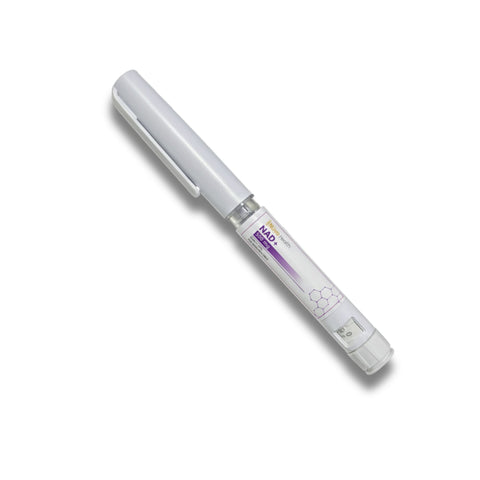
NAD+ Research Pen – 500mg & 1000mg | PrefilledNŪVO HEALTH PEPTIDES
 NEWIn stock
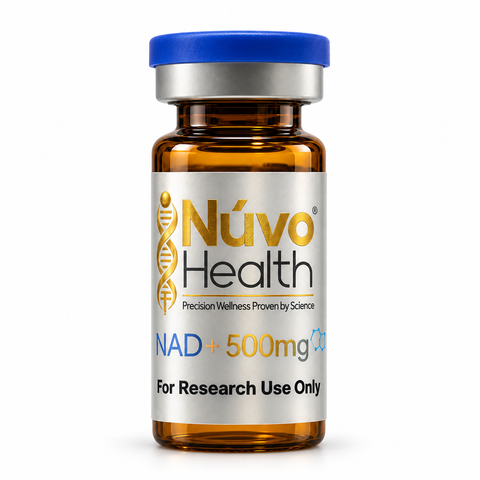
Supplied for laboratory research use only. Not for human or veterinary use.
