



Selank: examining the GABA-related research
NŪVO Insights · Emerging science. Clearly explained.
What gene-expression and binding experiments reveal—and why they do not settle clinical claims about anxiety or cognition.
Neuroscience often begins with a measurable change in a model: a receptor interaction, a shift in gene expression or a difference in animal behaviour. These observations can be valuable, but translating them into a claim about how a person feels requires additional evidence.
Selank, a synthetic heptapeptide, appears in research on neurotransmission and stress-related biology. GABA-related findings are frequently used to explain its proposed activity. A careful account needs to distinguish those experimental findings from claims that it is a proven treatment for anxiety or a reliable cognitive enhancer.
What GABA-related research is asking
GABA is an important inhibitory neurotransmitter. Researchers studying GABA-related systems may examine receptor binding, the expression of receptor components or the activity of connected pathways. These approaches provide different kinds of information.
In a 2016 study, investigators measured the expression of 84 neurotransmission-related genes in rat frontal cortex after exposure to Selank or GABA. [1] This was a molecular experiment in an animal model, designed to investigate patterns of response.
The result should not be described as proof that Selank “balances GABA” in people. That phrase compresses a complex set of measurements into a clinical-sounding claim without defining what balance means or how it was assessed.
Cell experiments add another layer
A 2017 study examined GABA, Selank and olanzapine in IMR-32 cells, focusing on genes involved in GABAergic neurotransmission. [2] Cell systems can help isolate molecular responses and compare experimental conditions.
They do not reproduce a whole human brain. They also do not measure lived experiences such as worry, concentration, sleep quality or the ability to function at work. A gene-expression result can suggest where to investigate next without establishing those outcomes.
The fact that an experiment includes an established medicine as a comparator does not make all substances in that experiment clinically equivalent. Comparison within a laboratory model answers the model’s question, not every treatment question.
Binding is a mechanism clue, not a treatment verdict
A 2018 study investigated aspects of Selank activity involving GABA binding and reported a pattern consistent with positive allosteric modulation in the experimental system. It also examined interactions with some benzodiazepines. [3]
An allosteric effect involves changing how a biological target behaves through an interaction that is distinct from the main binding event. Such findings can help develop a mechanistic hypothesis.
They do not establish that a compound has the same benefits as a benzodiazepine, avoids all of its risks or can be safely combined with one. Each of those claims requires its own clinical evidence.
Why anxiety and cognition need separate outcomes
Anxiety symptoms, attention, memory and sedation are not a single endpoint. A useful human trial needs to define which problem is being studied and use appropriate measures, comparison groups and follow-up.
It should also account for baseline symptoms, other medicines and the possibility of adverse effects. An intervention that changes one test score does not automatically improve daily functioning. Likewise, a short study cannot settle questions about long-term exposure, dependence or withdrawal.
The mechanistic studies discussed here do not answer those broader clinical questions. They should not be converted into a personal-use protocol or a claim that Selank provides calm without trade-offs.
The value of precise wording
There is a substantial difference between saying that researchers observed GABA-related effects in an experimental model and saying that a peptide safely treats anxiety. The first preserves a useful scientific finding. The second goes beyond the cited evidence.
At NŪVO, the aim is to keep the interesting biology visible while making the level of evidence equally clear. That allows readers to follow emerging neuroscience without mistaking early mechanisms for established care.
Sources and further reading
- Volkova et al.: neurotransmission-related gene expression in rats (2016)
- GABA, Selank and olanzapine in IMR-32 cells (2017)
- Vyunova et al.: molecular aspects of Selank activity (2018)
This article is provided for general educational purposes only. It is not medical advice and does not recommend the use, dose or sourcing of a prescription medicine or experimental compound. Consult an appropriately qualified healthcare professional about health concerns.
Explore the NŪVO research library
Hero image: conceptual scientific illustration; not a molecular model or evidence of a treatment effect.
Available to order
Compounds in this article
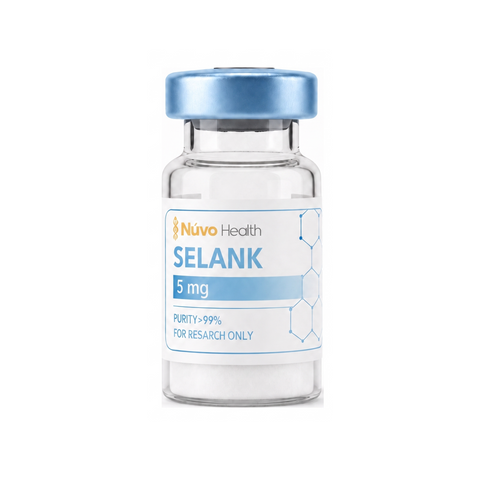
Supplied for laboratory research use only. Not for human or veterinary use.
