


DSIP: why a sleep-related name is not proof of better sleep
NŪVO Insights · Emerging science. Clearly explained.
What early human research reveals about the difference between a measurable signal and a useful treatment.
“Delta sleep-inducing peptide” sounds as though it describes a settled clinical effect. In reality, DSIP is better approached as a research topic with a name that reflects its scientific history. The name itself cannot tell us whether an intervention reliably improves sleep for people.
Sleep research is particularly sensitive to that distinction. Falling asleep, staying asleep, feeling restored and functioning well during the day are related but separate outcomes. A substance can affect a measurement without delivering a meaningful improvement across those experiences.
The most useful place to start: a controlled human study
A double-blind study published in 1992 investigated DSIP in patients with chronic insomnia. It reported higher sleep efficiency and shorter sleep latency compared with placebo. However, other measures, including subjective sleep quality, did not improve. The authors did not consider the short-term treatment likely to provide a major therapeutic benefit. [1]
This is a more informative account than selecting the two favourable measurements and omitting the overall conclusion. It also avoids the opposite error of pretending that no signal was observed. Both the measured changes and their limitations belong in the same explanation.
Sleep latency refers to how long it takes to fall asleep. Sleep efficiency concerns the proportion of time in bed spent asleep. Those measures help characterise a night’s sleep, but they do not fully describe whether a person feels better or functions better the next day.
What the earlier biology can contribute
DSIP has also been investigated in animal experiments. A 1984 study examined passage of labelled material across the blood–brain barrier in rats. [2] Such work can address questions about distribution under specified experimental conditions.
It does not show that a commercial preparation reaches the same target in people, at the same exposure, by a different route. Chemical labels, species differences and the way a substance is administered all matter when interpreting distribution research.
Another experiment investigated a possible role for DSIP in sleep-related growth-hormone release in rats. [3] This connects the research to broader questions about sleep and endocrine physiology. It should not be repurposed as evidence that DSIP improves overnight recovery or hormone health in humans.
Why subjective outcomes deserve attention
Patient-reported sleep quality is sometimes dismissed as less scientific than a laboratory measurement. Yet an intervention for insomnia should ultimately help with the problem the person experiences. Objective and subjective outcomes can provide complementary information.
If a study shows a change on one measure but not another, the discrepancy deserves investigation. It might reflect the scale of the effect, the duration of the study, the population or limitations in measurement. It should not be resolved by simply choosing whichever result makes the most attractive headline.
The same principle applies to commercial sleep scores. A higher number is only useful if the measure is valid and the change corresponds to something meaningful. No single score can substitute for a complete assessment of sleep and daytime function.
What a stronger research programme would need
Larger, well-controlled studies would need to establish which sleep problem is being investigated, how outcomes are measured and whether any benefit persists. Adverse effects and next-day impairment would need deliberate assessment rather than being inferred from a lack of complaints.
Replication would also matter. A finding should ideally be reproduced by independent groups using clearly defined materials. Older exploratory studies can motivate that work, but their age alone does not make an intervention established.
The studies discussed here do not support a dosing recommendation or self-directed use. Persistent sleep problems are a reason to seek appropriate assessment, rather than assuming that a research peptide addresses the underlying cause.
The NŪVO perspective
DSIP is a useful reminder that scientific names often preserve a hypothesis or an early observation. Good evidence communication starts with the actual experiments and checks whether the name is being asked to do more work than the data.
Sources and further reading
- Bes et al.: double-blind study in chronic insomnia (1992)
- Banks et al.: labelled DSIP blood–brain barrier experiments (1984)
- Iyer et al.: sleep-related GH research in rats (1988)
This article is provided for general educational purposes only. It is not medical advice and does not recommend the use, dose or sourcing of a prescription medicine or experimental compound. Consult an appropriately qualified healthcare professional about health concerns.
Explore the NŪVO research library
Hero image: conceptual scientific illustration; not a molecular model or evidence of a treatment effect.
Available to order
Compounds in this article
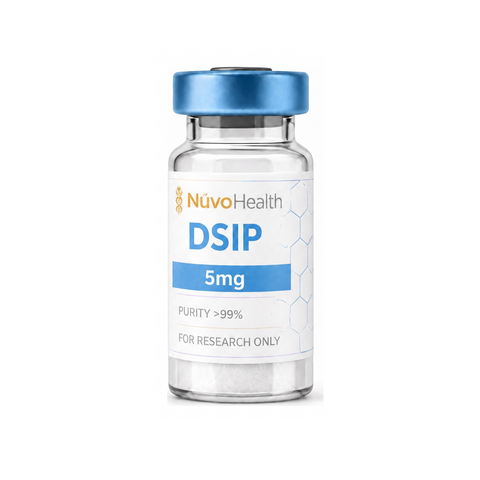
Supplied for laboratory research use only. Not for human or veterinary use.
