
BPC-157 and tissue research: what the experiments can tell us
NŪVO Insights · Emerging science. Clearly explained.
A closer look at tendon studies, cell signalling and the gap between preclinical findings and clinical recovery.
Tissue repair is not one event. Cells must respond to damage, move into the affected area, produce and reorganise a supporting matrix, and eventually restore useful function. A compound can influence one part of that sequence without demonstrating that it improves the entire process in people.
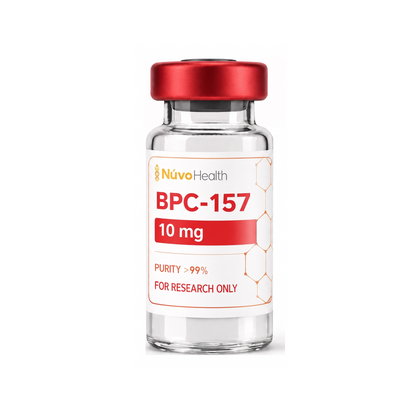
BPC-157 is an experimental peptide containing 15 amino acids. Its research profile includes studies of tendons and the cells involved in maintaining connective tissue. Those experiments help explain the interest in the molecule. They also show why the word “recovery” needs careful qualification.
Three useful windows into the research
A 2003 study investigated surgically injured Achilles tendons in rats. The investigators assessed multiple features, including the tissue’s mechanical properties and functional measures, rather than relying on appearance alone. They reported favourable findings in the treated animals. [1]
That is evidence from an animal injury model. A surgically created injury in a rat is not the same as chronic tendon pain, age-related changes or a sports injury in a person. The distinction is central to interpreting the result, rather than a minor footnote.
A 2011 experiment examined tendon explants and cultured tendon fibroblasts. Fibroblasts are cells that contribute to connective tissue. The researchers reported changes in tissue outgrowth, survival under stress and cell migration, alongside findings involving the FAK–paxillin signalling pathway. [2]
A further study reported increased expression of growth-hormone receptors in tendon fibroblasts exposed to BPC-157. [3] Receptor expression concerns how cells may respond to a signal; it does not establish that a person will heal faster or that combining compounds will produce a clinical benefit.
Why movement in a dish is an incomplete outcome
Migration experiments can help scientists understand whether cells move differently after an intervention. They cannot reproduce the full mechanical demands on a living tendon. Real tissue must withstand load, coordinate with nearby structures and function over time.
The same caution applies to biochemical markers. A change in a signalling protein can suggest a mechanism worth investigating, but the size of that change does not translate directly into days saved from rehabilitation. An experiment about cellular behaviour and a clinical question about returning to activity are different kinds of question.
This is why precise language helps. “Increased migration of cultured tendon cells” communicates what was measured. “Repairs tendons” leaves the model, uncertainty and outcome undefined.
What would make a human claim convincing?
A useful clinical study would define the injury clearly, use an appropriate comparison group and measure outcomes that matter to patients. Pain, function, return to activity and reinjury are not interchangeable. Improvement in one measure should not be presented as improvement in all of them.
The study would also need to account for rehabilitation, changes in training and other treatment. These factors can affect recovery and make uncontrolled experiences difficult to interpret. Follow-up would have to be long enough to assess both the durability of any benefit and possible harm.
The representative studies discussed here do not provide that clinical evidence. Their importance lies in generating and testing biological hypotheses. They do not establish a validated human treatment or a personal-use protocol.
Questions worth keeping open
It remains important to distinguish which tissue is being studied, which experimental model was used and whether an observation has been reproduced independently. Results in a particular injury model should not be extended automatically to the gut, nerves, skin or every type of connective tissue.
Likewise, a proposed mechanism is not evidence of safety. A research programme needs to investigate unwanted effects as deliberately as it investigates desired ones. The absence of a reported problem in a limited experiment cannot answer every question about longer exposure or a different population.
The NŪVO perspective
BPC-157 is best explained through the experiments themselves: what researchers tested, the signals they observed and the next questions those findings create. That approach preserves the scientific interest without asking a cell or animal study to prove something it was never designed to establish.
Sources and further reading
- Staresinic et al.: rat Achilles tendon research (2003)
- Chang et al.: tendon outgrowth, survival and migration (2011)
- Chang et al.: growth-hormone receptor expression in tendon fibroblasts (2014)
This article is provided for general educational purposes only. It is not medical advice and does not recommend the use, dose or sourcing of a prescription medicine or experimental compound. Consult an appropriately qualified healthcare professional about health concerns.
Explore the NŪVO research library
Hero image: conceptual scientific illustration; not a molecular model or evidence of a treatment effect.
Available to order
Compounds in this article
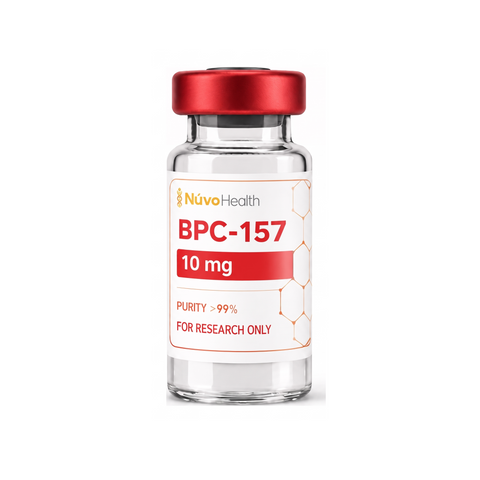
Supplied for laboratory research use only. Not for human or veterinary use.
