
KPV: a small peptide in inflammation research
NŪVO Insights · Emerging science. Clearly explained.
How studies of transporters and intestinal models help researchers ask more precise questions.
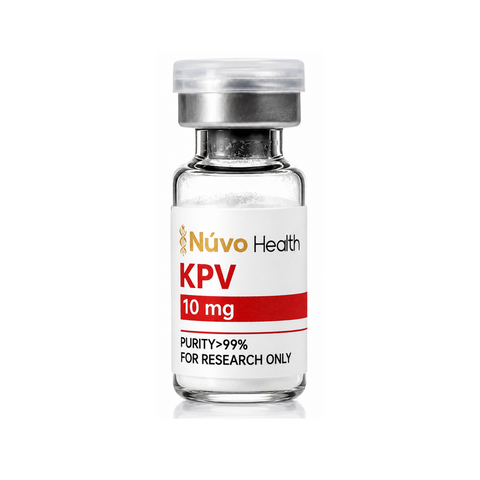
Small molecules can generate large research questions. KPV contains just three amino acids—lysine, proline and valine—but its experimental literature reaches into cell transport, inflammatory signalling and the biology of the intestinal lining.
Its size does not make its effects straightforward. For researchers, an important question is not only what KPV can do in a model, but also how it reaches the relevant cells and whether the experimental context changes the response.
Why a transporter appears in the story
One influential study investigated KPV uptake through PepT1, a transporter involved in moving small peptides across cell membranes. The researchers examined intestinal epithelial and immune-cell systems, together with mouse models of colitis. [1]
This is useful because an intervention has to reach the place where its proposed activity occurs. A finding about cellular uptake can help explain an experimental effect and guide further work on delivery.
However, transporter involvement is not equivalent to a complete treatment mechanism in people. A living intestine contains multiple cell types, changing environmental conditions and interacting immune signals. A model can isolate part of that complexity without reproducing all of it.
What the mouse studies contribute
A separate 2008 study reported anti-inflammatory effects in two murine colitis models. It assessed outcomes such as weight changes, tissue findings and myeloperoxidase activity, a measure used in inflammatory research. [2]
Using several outcomes is more informative than measuring one signal alone. It allows researchers to check whether changes at different levels point in a consistent direction. Even so, the conclusion remains about the tested models.
Experimentally induced colitis in mice is not interchangeable with Crohn’s disease, ulcerative colitis, irritable bowel syndrome or nonspecific digestive symptoms in people. Those conditions differ, and the same word—“inflammation”—does not make their causes or treatment requirements identical.
Delivery is part of the intervention
A 2017 study investigated KPV delivered through hyaluronic-acid-functionalised nanoparticles in an experimental colitis setting. [3] This makes an important point about the research: the delivery system can be an active part of the scientific question.
Results obtained with a targeted carrier cannot be assumed to apply to an unformulated peptide. The carrier may affect where the material accumulates, how cells take it up or how long it remains available. The tested intervention is therefore more specific than “KPV”.
When reading a study, keep the formulation attached to the result. A paper about a delivery technology should not become a general efficacy claim for every material sold under the same peptide name.
What “anti-inflammatory” does and does not mean
In a research paper, the term may refer to a change in a selected signalling pathway, a cytokine measurement or a feature of an animal model. It does not automatically mean that an intervention improves symptoms, prevents complications or is safe for long-term use in humans.
Inflammation is also not a single process that should always be reduced indiscriminately. The useful clinical question is whether a defined intervention improves a defined condition with an acceptable balance of benefit and harm.
That requires appropriate human studies. The experiments described here generate a rationale for further investigation; they do not provide a validated treatment plan for digestive disease or skin conditions.
How to assess the next KPV claim
Check whether the evidence concerns cells, animals or people. Identify the formulation and the outcome. If a statement refers to a human condition, ask whether that condition was actually studied, rather than inferred from a model carrying a similar label.
It is also worth separating a claim about mechanism from a claim about clinical usefulness. Showing that a peptide influences a pathway can be scientifically meaningful even when its practical value remains uncertain. Both statements can be true at once.
The NŪVO perspective
KPV is best presented as a topic in inflammatory signalling and experimental delivery research. The work is interesting because it asks specific questions about uptake and response, not because a three-letter name provides a shortcut through the complexity of human disease.
Sources and further reading
- Dalmasso et al.: PepT1-mediated KPV uptake (2008)
- Kannengiesser et al.: KPV in murine colitis models (2008)
- Targeted KPV nanoparticle delivery study (2017)
This article is provided for general educational purposes only. It is not medical advice and does not recommend the use, dose or sourcing of a prescription medicine or experimental compound. Consult an appropriately qualified healthcare professional about health concerns.
Explore the NŪVO research library
Hero image: conceptual scientific illustration; not a molecular model or evidence of a treatment effect.