
TB-500 and thymosin beta-4: why molecular identity comes first
NŪVO Insights · Emerging science. Clearly explained.
How analytical research helps prevent evidence from being assigned to the wrong peptide.
Before asking what a peptide does, it is worth asking exactly which peptide is being discussed. That sounds obvious, but TB-500 descriptions often blur the distinction between a short fragment and full-length thymosin beta-4.
The distinction matters because a name is not an analytical result. A paper about one molecular structure cannot automatically validate a different material that happens to be described with a related label.
What an analytical investigation identified
A 2012 study examined a product labelled TB-500 and identified an N-terminally acetylated fragment corresponding to residues 17–23 of human thymosin beta-4. The reported sequence was Ac-LKKTETQ. The investigators used chromatography and high-resolution mass spectrometry to characterise it. [1]
This is a specific finding about the material examined. It is not proof that every product sold under the TB-500 name contains that sequence. Commercial naming needs to be checked against the actual molecular specification and analytical evidence.
Equally, that identified fragment should not simply be called full-length thymosin beta-4. A portion of a molecule and the complete molecule are distinct research subjects.
Why fragments do not inherit every property of a parent molecule
A peptide’s structure affects its interactions, breakdown and distribution. A fragment may retain an activity associated with one region of a larger peptide, while differing in other respects. Whether that happens needs to be tested.
Consequently, a full-length thymosin beta-4 study is not sufficient evidence for a fragment’s clinical effect. Nor does activity observed for a fragment establish the behaviour of the full-length molecule under different conditions.
The appropriate reading habit is to match the sequence and modifications in the paper to the compound named in the claim. If that match cannot be established, the conclusion needs to remain qualified.
What detection studies can—and cannot—show
Another 2012 investigation developed liquid chromatography–mass spectrometry methods for TB-500 and its metabolites in equine urine and plasma. [2] The objective was analytical detection in a doping-control context.
Such a study can provide evidence that a substance or its breakdown products can be identified after exposure. It does not demonstrate improved healing, athletic performance or safety in people.
This is an important example of why the presence of a published paper is not enough. The paper’s question must match the claim being made. An analytical method can be technically strong while saying nothing about clinical effectiveness.
More recent preclinical work
A 2024 study investigated methods for measuring TB-500 and its metabolites, alongside comparisons of biological activity in in-vitro wound-healing assays. [3] This connects analytical characterisation with exploratory functional testing.
An in-vitro wound-healing assay typically examines behaviour such as cell movement in a controlled system. It does not reproduce the complete process of a human tendon, ligament or muscle recovering under load.
The findings can help identify which material or metabolite merits further study. They cannot establish that a person will recover from injury faster or that a combination with another peptide is effective.
What a useful product-independent discussion includes
Start with the exact sequence, relevant modifications and the source of the material. Then identify whether the evidence is analytical, cellular, animal or clinical. Finally, match the outcome to the conclusion.
For example, “identified by high-resolution mass spectrometry” is a statement about characterisation. “Changed a cell-assay result” is a statement about a model. Neither should be converted into “clinically proven recovery”.
Quality measurements also need their own boundaries. A purity figure does not resolve every question about identity, amount or suitability. Those questions require methods designed to answer them.
The NŪVO perspective
The most useful TB-500 article begins with clarity about the molecule. That prevents evidence from different thymosin-related materials being combined into an apparently stronger claim than any individual study supports.
Sources and further reading
- Esposito et al.: identification of an acetylated fragment in TB-500 (2012)
- Ho et al.: LC-MS analysis in equine samples (2012)
- TB-500 metabolites and in-vitro wound-healing assays (2024)
This article is provided for general educational purposes only. It is not medical advice and does not recommend the use, dose or sourcing of a prescription medicine or experimental compound. Consult an appropriately qualified healthcare professional about health concerns.
Explore the NŪVO research library
Hero image: conceptual scientific illustration; not a molecular model or evidence of a treatment effect.
Available to order
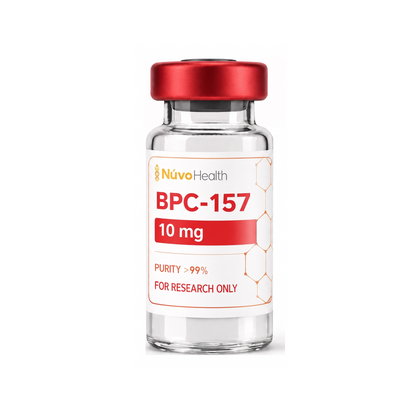
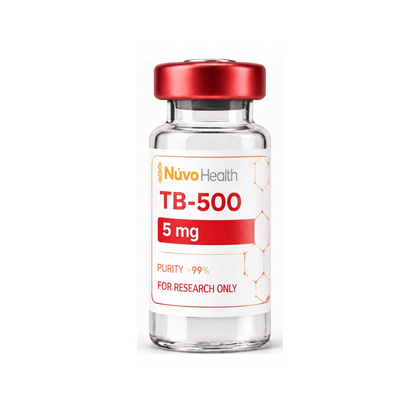
Compounds in this article
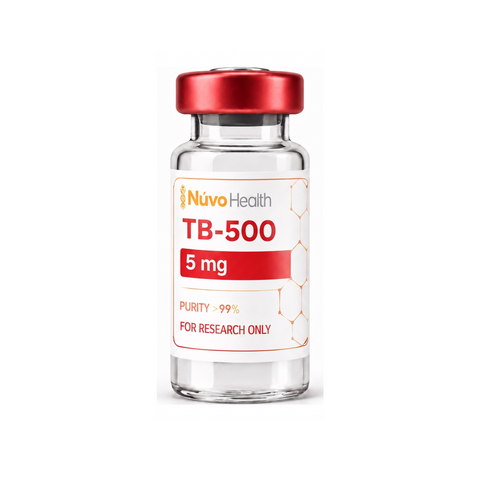
Supplied for laboratory research use only. Not for human or veterinary use.
