
Understanding lyophilisation
Most research peptides are supplied as a lyophilised — freeze-dried — powder. Lyophilisation removes water from a frozen sample under vacuum, leaving a dry, stable solid that keeps far longer than a solution.
How freeze-drying works
- Freezing — the sample is frozen solid, locking its structure in place.
- Primary drying — under deep vacuum, the frozen water sublimes directly from ice to vapour without passing through a liquid phase, which is gentle on fragile molecules.
- Secondary drying — a slight temperature increase drives off the small amount of water still bound to the material.
Why peptides are lyophilised
Peptides in solution are vulnerable to hydrolysis, aggregation and microbial growth. Removing the water dramatically slows these processes, so a lyophilised peptide is more stable in storage and transport and has a longer usable life.
What the powder looks like
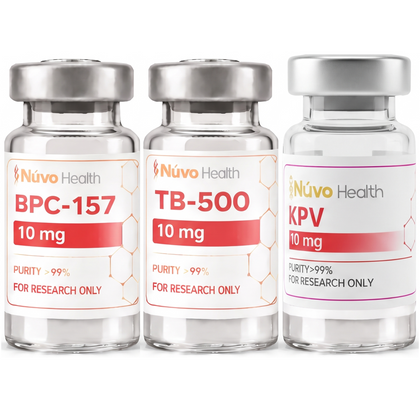
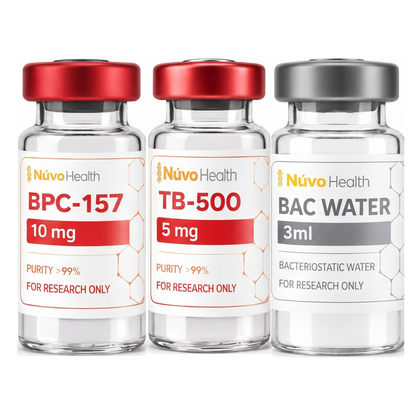
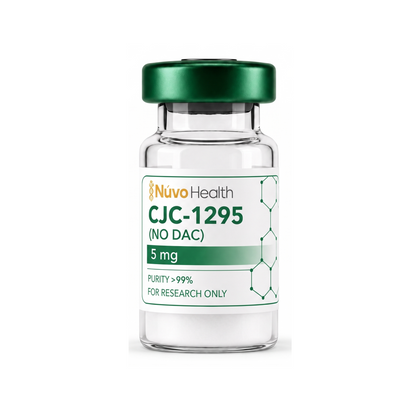
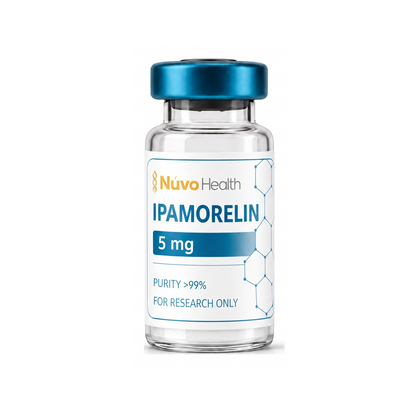
Lyophilised peptide can appear as a fluffy cake, a thin film, or a fine powder, and the visible quantity of a few milligrams can be surprisingly small — sometimes barely visible at the bottom of the vial. This is normal and is not an indication of the amount present, which is defined by the batch documentation rather than by appearance.
Handling considerations
- Keep vials sealed and stored as stated on the Certificate of Analysis, typically refrigerated and protected from light and moisture.
- Allow a cold vial to reach room temperature before opening, so condensation doesn't form on the powder.
- Minimise exposure to air and humidity during handling.
For laboratory and research use only. Not for human or animal consumption. Nūvo Health does not provide dosage, administration, or clinical guidance.